
Want more Origen Stories?
Origen x University of North Florida: Making Water From Air
Real-world water generation prompts valuable insights into the future of sustainable technology.
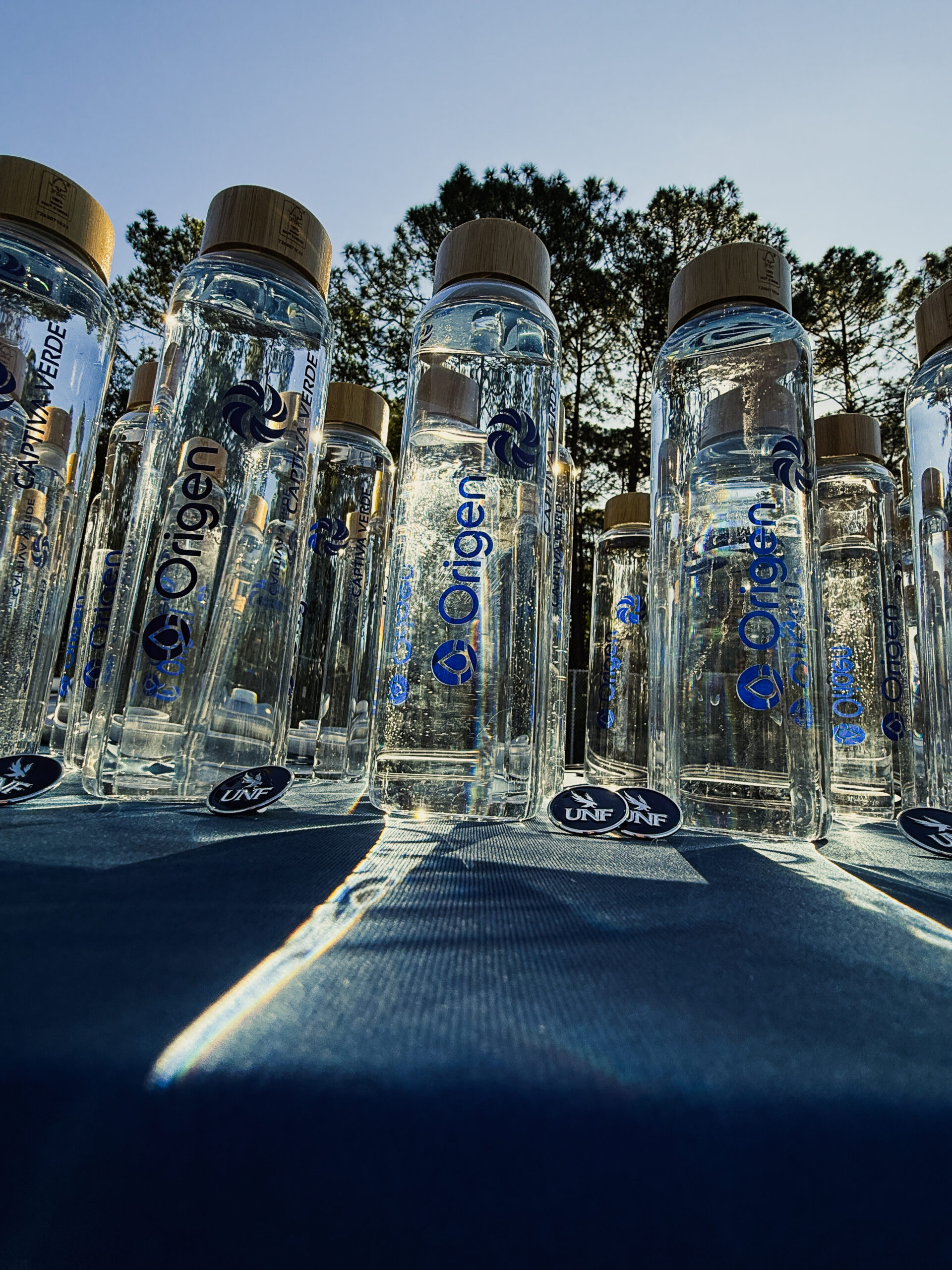
Nearly six months into a pilot program at the University of North Florida (UNF), Origen’s Wellspring 100 is performing well, making waves toward more sustainable practices in Florida and beyond.
The End of Phase One
On January 30th, Origen unveiled the Wellspring 100, a new atmospheric water generator (AWG) designed to make water from air. Partnered with the University of Florida Sustainable Solutions Lab and distribution partner Captiva Verde, Origen began a six-month study to evaluate the Wellspring 100’s performance in northern Florida conditions.
Origen’s team traveled back to the pilot site for a routine check-in on the Wellspring 100 just last month.
“We just got our first water quality test back from the third-party lab, and everything is tracking where it needs to be. PFAS, PFOAs, all that came back negative, which is what we wanted to see. No bacteria, no viral contaminants. And all of the volatile chemicals are exceeding EPA standards,” said Walt Waetjen, Senior Director of Product and Business Development for Therma-Stor, parent company of Origen.
Origen AWGs filtration system consists of a multi-step process. Air enters the water generation machine and passes through a filter, trapping 90% or more common airborne contaminants.1
The air, now condensed into water, is then sterilized and rebalanced, restoring nutrients like calcium and magnesium. Finally, the water is disinfected using UV light. What you’re left with is clean, safe, and drinkable water.
According to Waetjen, the Wellspring 100’s 4-step filtration was put to the test during peak pollen season this past spring. Ultimately, the water showed no signs of contamination afterward.
Comparatively, the Wellspring 100 displayed no signs of corrosion or electrical failures, requiring only minor adjustments to its float switches and software.
Thanks to on-site studies like the one at UNF, Origen has been able to fulfill its goal of field-testing the AWG before it goes into production. The new information allows the team to refine the Wellspring 100 and remove any potential kinks that may arise from real world use.
Even though data drives improvement, it’s only a piece of a much larger puzzle.
Beyond the Data
Data isn’t the only resource being gathered in north Florida — experience and education are too.
Students at UNF, ranging from undergraduate to post-graduate scholars, can work with the AWG pilot study to gain real-world exposure to sustainable water technology. Each day, they empty the tank, check the data loggers, and conduct a visual review of the Wellspring 100.
In addition to experience, students are able to supply other sustainability initiatives at the lab using water created by the atmospheric water generator. For example, they are testing hydrogen fuel cells as a power source in both a golf cart and a car.
According to Waetjen, “What they would typically do is they would buy pure water, deionize it, and then use it for their hydrogen fuel cells. Instead, what they’ve been able to do is they can use our water… still send it through the deionizer, but it makes their deionizer’s cartridges last longer because it’s not having to do as much purification.”
Entering Phase Two
Thanks to the operational success of the Wellspring 100 thus far, Origen and UNF decided to extend the AWG study past the original six-month timeline.
“We’ve talked about this extending out, you know, several years, just continuing this partnership. In July, we’ll probably swap out that prototype unit and give them a production unit and continue the study with a production unit,” said Waetjen. The new production unit will be nearly identical to the current prototype, with minor revisions based on research from both teams.
During Phase Two, researchers will continue testing the Wellspring 100 with a focus on real-world performance data as noted at the start of the study. In addition, the studies will center around system efficiency and user experience.
Waetjen hopes to gain more data as time goes on to continue innovating the already-efficient atmospheric water generation machine.
Exploring Microgrids
As one study extends, another is launched.
“We’ve sent them some other [Origen prototypes] now that they’re piloting on what they’re calling microgrids,” said Waetjen, “They’re taking a 20-foot shipping container, they’re putting solar panels on the roof, with inverters and equipment inside.”
According to Waetjen, deployable microgrids can serve numerous purposes, from disaster relief to off-grid living. In this case, UNF is testing the Origen prototypes in hopes of creating sustainable water generation within microgrid applications. “More to follow on that as they get deeper into their research,” said Waetjen.
It’s a Win-Win
This “win-win” situation, as Waetjen refers to it, delivers not only information, but education, experience, and tangible resources to students at UNF and Origen’s team back in Wisconsin.
As the pilot study in northern Florida progresses, the Origen Wellspring 100 will continue to test the waters as it enters Phase Two, changing the future of sustainable water as we know it.
Interested in joining the sustainable water movement? Contact our team.
Explore more Origen Stories.
- United States Environmental Protection Agency. “What is a MERV rating?” Epa.gov https://www.epa.gov/indoor-air-quality-iaq/what-merv-rating Accessed Sept 2026.