
Origen x University of North Florida: Turning Research Into Water Resiliency
The six-month study aims to address critical water challenges in the state of Florida
Like many things in Florida, water moves differently than it does in other states.
Known as the “Springs Capital of the World,” Florida has more than 1,000 recognized freshwater springs. And while these springs are essential for water storage, they are especially susceptible to contamination—a sizable problem considering they supply about 90% of the state’s drinking water.
This vulnerability makes innovative water solutions essential.
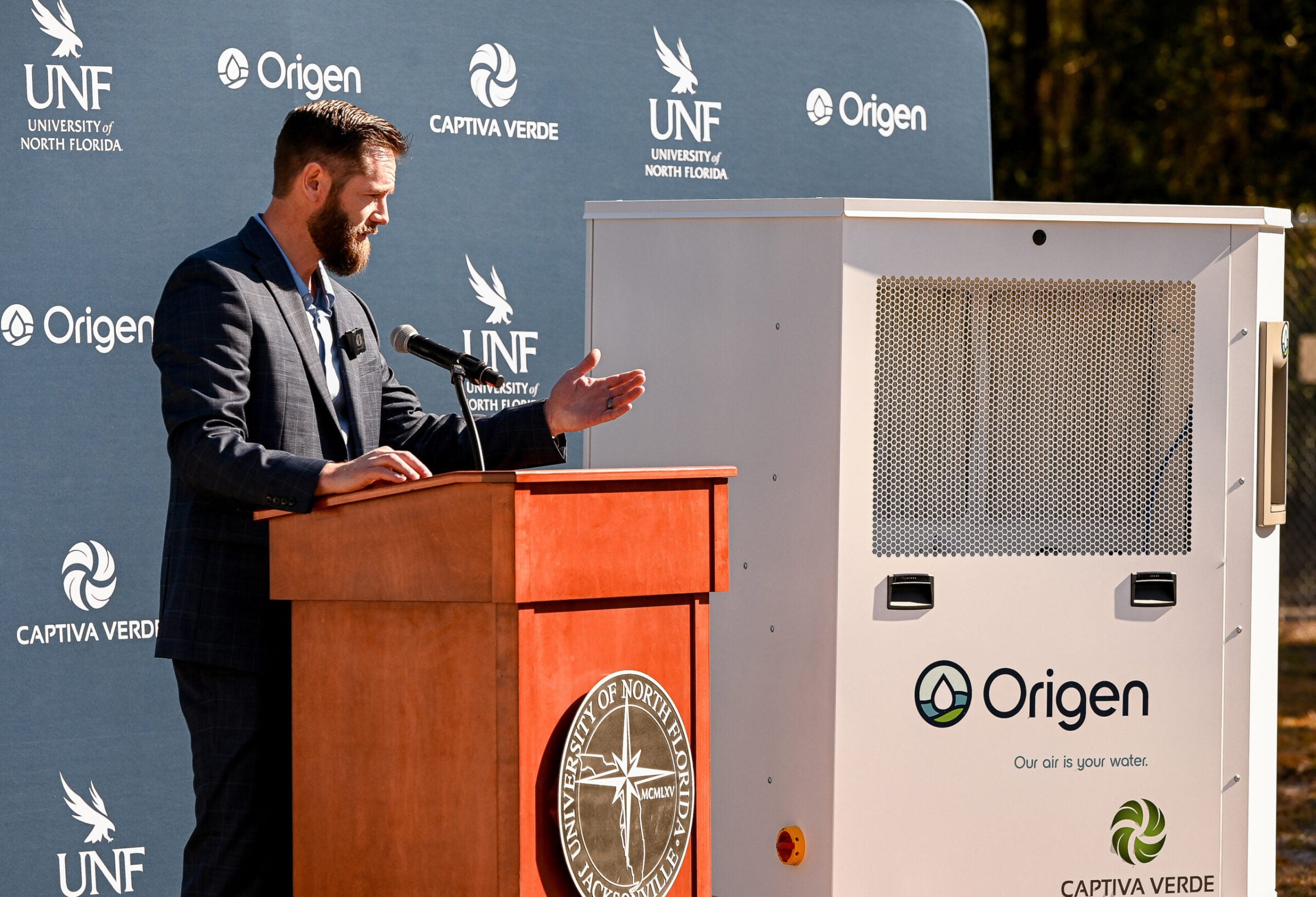
To address this challenge, the University of North Florida (UNF) partnered with Origen to perform a six-month study on its Wellspring 100, an atmospheric water generator (AWG). In that time, UNF will conduct resiliency research to better protect the state’s aging water infrastructure.
In addition to concerns surrounding contamination, the state’s water supply faces another threat.
“We get a lot of storms in Florida,” said Jim Fletcher, Ph.D., associate professor of engineering at UNF. “People can be without drinking water for days, and the water from grocery stores disappears before the storm hits. We want to see if the Wellspring 100 can be an alternative solution.”
To understand how the Wellspring 100 would work as an emergency solution, it’s important to grasp how the machine operates.
How the Wellspring 100 Works
The Wellspring 100 generates clean drinking water through a four-step process:
- Its patented coil design extracts and condenses moisture at 15% relative humidity (RH).
- Its three-stage microfiltration process gets rid of sediment, bacteria, and viruses.
- Its remineralization process restores taste.
- Its storage vessel pumps water up to taps, ice machines, and irrigation lines.
How the Wellspring 100 works is relatively simple, but there are feasibility factors that still need to be tested. That’s what makes UNF’s role important and additional research necessary.
A New Approach to Water Security
The goal of the Wellspring 100 is to empower companies and organizations to produce their own drinking water. As water infrastructure strains and climate concerns intensify, on-site water generation is no longer nice-to-have; it’s essential.
In addition to being a viable alternative to drinking water, the Wellspring 100 is a resource for companies looking to reduce their environmental footprint. In fact, it produces 103 gallons of potable water per day without relying on municipal lines, trucking, or bottled water. These are all significant advantages when infrastructure is already damaged and overwhelmed.
“The Wellspring 100 represents resilience,” said Walt Waetjen, senior director of product and business development for Therma-Stor, the parent company of Origen. “It represents the idea that clean water doesn’t have to depend on pipelines, trucks, desalination, depleted aquifers, or forever chemicals. It can be produced on-site sustainably and reliably.”
Recognizing the need for generating potable water is one thing, but actually getting people to drink it? That’s a different story.
“People need to warm up to the idea of drinking water from a machine,” Dr. Fletcher says. “In some cases, that machine could be in the middle of nowhere in a field.”
Understanding this psychological barrier is an important part of UNF’s research.
UNF’s Research Focus
Dr. Fletcher’s students are focusing on real-world performance data, validating system efficiency, and assessing user experience in the Sustainable Solutions Lab on UNF’s campus. They’re evaluating all three factors, he says, by getting the industry, government, and academia involved.
“There’s no point in doing research for research’s sake,” says Dr. Fletcher. “You need all three sectors to perform meaningful research with real-world applications and with realistic limits.”
As a water industry player, Origen is helping shape UNF’s research approach. Rather than focusing on research that’s the most interesting to them, infrastructure needs take precedence.
“The Center for Utility Security and Resiliency is designed to address emerging challenges in energy, water and infrastructure through rigorous, application‑focused research,” says Dr. Paul Eason, vice president of strategy and innovation at UNF. “Growing UNF’s research infrastructure depends on projects like this, which expand our capacity to validate new technologies and deliver innovative solutions.”
Looking to the Future
Through the beginning of July, researchers will take a close look at the machine and what it’s capable of. They are specifically focusing on how efficient the system is and how easy it is to use while collecting real-time data.
“We take pride in having a hands-on lab,” says Dr. Fletcher. “Our students will be working with the machine to understand how it works and the benefits it has to offer.”
This hands-on approach has drawn attention beyond the student body.
The unveiling ceremony on Jan. 30 was a resounding success, underscoring the need for alternative potable water solutions in Florida. UNF was able to send its message to key industry stakeholders. Among the attendees was U.S. Representative John Rutherford, who delivered that message in his speech.
“It is great to see the collaboration between UNF and private industry in action as they work together to research and develop cutting-edge, resilient technology here in Northeast Florida,” he said.
While water moves differently in Florida, alternative potable solutions are moving faster through cross-sector partnerships like this. Climate change and aging infrastructure will continue to strain the industry for the foreseeable future. The question isn’t whether on-site water generation is necessary; it’s how fast it can be deployed at scale in regions that really need it.